

Pressure Is A Privilege: If You Know What To Do With It!
Leaders sometimes refer to pressure like it's something to survive. Get through the quarter. Get through the launch. Get through the conversation you've been avoiding. Survive it, and then, presumably, life gets easier.
Here's a reframe worth sitting with: pressure is a privilege.
Not because it feels good. It rarely does. But because pressure is often a sign that you've been trusted with something that matters. The team that's counting on you to make the right call. The budget you were given because someone believed you could grow it. The hard conversation that's yours to have because you're the one with the standing to have it. Pressure is often what responsibility feels like from the inside.
And not all of that pressure happens at work.
Sometimes it's a struggling relationship. A conversation with your spouse that keeps resurfacing. An aging parent whose needs are increasing. A child making decisions you can't control. A friendship that suddenly feels strained. A financial situation that seems never ending and unsurmountable.
Relational pressure can actually be harder to carry than organizational pressure because the people involved aren't simply colleagues or employees. We love them. We have history with them. Their decisions affect us, and ours affect them. And personal pressure rarely stays contained. What happens at home follows us to work, just as what happens at work follows us home. We are integrated beings, not right or wrong. It’s a simple reality. Recognizing the reality should make us more aware of ourselves and more thoughtful about the support and challenge that we extend to those close to us.
The absence of pressure isn't necessarily peace. Sometimes it simply means nothing important is being asked of us in that moment. A life organized around avoiding every form of pressure may feel safer, but it can also leave us unprepared to carry the things that matter most and less capable of carrying greater responsibility in the future.
But privilege without a process becomes burden fast. If you don't know what to do with pressure, being trusted with something that matters doesn't feel like an honor, it feels like drowning. Pressure may be a privilege, but only if we learn how to metabolize it. Without that, the same responsibility that can develop us can eventually diminish us.
Responding vs Reacting
Pressure doesn't just test our capacity. It tests our ability to respond rather than react.
Under pressure, our reactions tend to become faster and our perspective narrower. We catastrophize. We blame. We avoid. We control. We withdraw. We try to fix. We reframe responsibility.
Some of that is biology. Pressure activates systems designed to help us respond quickly to perceived threats. But we shouldn't use biology to explain away what pressure exposes.
Sometimes pressure reveals an old wound, trauma or an instinctive stress response. Sometimes it reveals a skill we haven't developed yet. And sometimes it reveals something in our character that needs attention. Pride, selfishness, dishonesty, insecurity, a need for control, or an unwillingness to own what belongs to us.
Pressure doesn't give us a pass on character. It gives us a window into it.
That's one reason pressure can be a privilege. It shows us things about ourselves that comfort can keep hidden and keep us in a place lacking maturity.
The leaders and people who learn to carry pressure well develop a small but important space between what is happening to them and what they do next. That space is where self-awareness becomes self-leadership. And it matters just as much at the kitchen table as it does in the conference room.
When Pressure Gets Transferred
One of the most revealing things about pressure is what we do with it once we feel it.
At work, transferring pressure can disguise itself as decisiveness or delegation. “I need to loop in the team on this” can really mean I'm avoiding a decision. “This is an operations problem” can be a way of distancing myself from a leadership problem. We can hand a task to someone else at the exact moment the task actually requires us.
But we transfer pressure relationally too.
Sometimes pressure leaks out in less obvious ways. We begin to undermine situations and relationships without fully acknowledging what we’re doing.
I’m anxious so I become controlling.
I'm afraid, so I make someone else responsible for reassuring me.
I'm frustrated, so everyone in the house feels it.
I'm uncomfortable with someone's decision, so I pressure them to change it, not necessarily because their decision is wrong, but because their decision is creating pressure in me.
The more capable we become, the more sophisticated our avoidance can become. We don’t disappear; we redirect. And before long, someone else is carrying what belongs to us.
One sign of maturity is the ability to carry pressure without unnecessarily transferring it to the people around us.
That doesn't mean carrying everything alone. Asking for help, sharing a burden, seeking counsel, or appropriately delegating are signs of wisdom. The question is whether we're sharing pressure intentionally or simply trying to escape the discomfort of owning what is ours.
The tell is usually a simple question, asked honestly: whose problem is this, actually, and am I making it someone else's because it's easier than sitting with it being mine?
CORE: A Tool for the Moment Pressure Hits
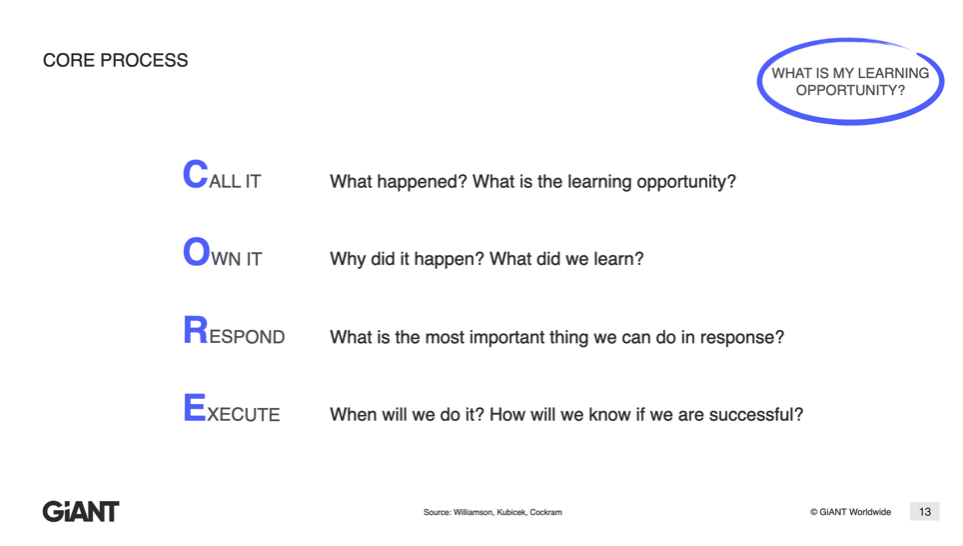
This is where a simple GiANT framework called CORE becomes useful, not as a philosophy, but as something to run through in the actual moment pressure lands.
Call It. What is actually happening here? Not the story I'm telling myself or perhaps those around, but the facts.
Own It. Applied to pressure, another way to frame this is to ask “What part of this belongs to me?” This question interrupts the reflex to reframe a problem as someone else's and helps us distinguish between what we need to carry and what we need to release.
Respond. What is the appropriate response, not simply my instinctive reaction? What is my action plan to know myself and lead myself well?
Execute. What do I need to do next? One clear, concrete action not a plan to fix everything at once. Include timelines and how accountability will work.
CORE doesn't remove the weight of what you've been trusted with. It gives you a way to carry it without either transferring it or being crushed by it.
The Real Work
You don't get to choose whether pressure shows up. If you're leading, loving, building, parenting, caring, creating, or taking responsibility for anything that matters, it will.
The goal isn't to eliminate pressure. And it isn't to glorify it. Too much pressure, applied for too long, can break people. Wisdom means knowing when pressure is stretching our capacity and when it is exceeding it.
But our first instinct doesn't have to be escape. Pressure can reveal what comfort keeps hidden. It can show us where our capacity needs to grow, where our character needs attention, and where we need to stop handing our internal pressure to everyone around us.
What we get to choose is what we do with it - whether we own it, process it, learn from it, ask for appropriate help, or quietly hand it to someone else.
Pressure is a privilege, not because pressure itself is good, but because what we do with it can form us into people capable of carrying greater responsibility without allowing the weight we’re carrying to become a weight everyone around us has to carry too.
If you're ready to build that capacity—for yourself or your team—schedule a free consultation with Klarity.
