

The Power of the Medium: Why Leadership Communication Breaks Down (Even When the Message Is Right)
It’s 7:07am.
On your way into work, you get a message from a team member:
“Can you help me understand what this means?”
They’ve forwarded a late-night group message from one of your managers.
As you read it, a few things are immediately clear:
- New expectations are being introduced
- Boundaries are being set
- Concerns are being addressed
But this is the first time anyone is seeing it.
No prior conversation.
No team input.
No alignment.
Just a message sent to the entire group expecting immediate buy-in.
The Impact
Within minutes, the ripple effects begin:
- Confusion about direction
- Questions about intent
- Frustration around how it was handled
And most importantly:
A lack of real alignment despite a clear message.
I’ve seen this immobilize teams, create unnecessary cleanup, and over time undermine strong leaders when the misuse of the medium becomes a pattern.
The Leadership Response
You connect with the manager and ask them to move the conversation into a face-to-face setting.
Because the issue isn’t just what was communicated. It’s how it was delivered.
In leadership communication, the “medium” is the method used to deliver the message—email, text, Slack, meetings, phone calls, or face-to-face conversation.
And the wrong medium can unintentionally create confusion, resistance, or misalignment before the conversation even begins.
The Hidden Issue: It’s Not the Message—It’s the Medium
Nothing in the message was necessarily wrong.
But almost everything about the medium was.
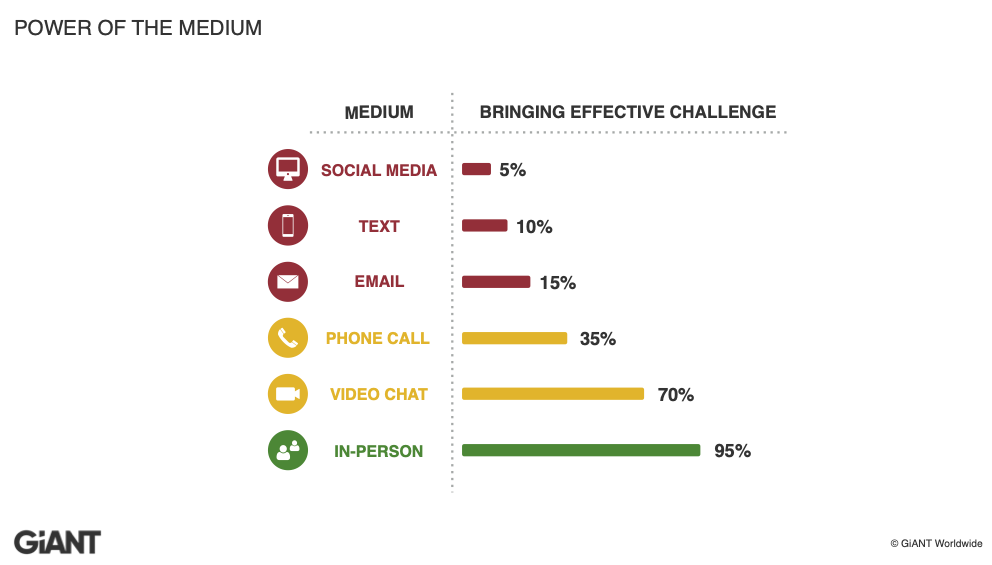
In the GiANT toolkit, this is known as the Power of the Medium—the principle that how you communicate shapes whether alignment actually happens.
Most teams don’t lose alignment in major moments. They lose it through repeated small communication decisions that slowly erode trust and clarity over time.
Where Leadership Communication Breaks Down
In working with leadership teams, we consistently see the same patterns:
1. Leaders use low-trust communication mediums (email, text, Slack, Teams, internal channels) for high-stakes conversations like feedback, accountability, or relational tension.
- Feedback sent over email
- Tension addressed in group settings
- Accountability softened in Slack, Teams, or internal channels
2. Teams overuse meetings and underuse decision structures
- Conversations happen, but decisions don’t
- Everyone feels heard, but no one owns the outcome
3. Leaders avoid the medium that requires the most courage: face-to-face conversation.
The Leadership Shift
High-performing leadership teams don’t just communicate more.
They communicate with precision.
Before delivering a message, they ask:
1. What outcome am I trying to create?
2. What level of clarity is required?
3. What level of trust is at stake?
4. What medium best supports that outcome?
A Simple Framework for Choosing the Right Medium
Information → Written (email, documents)
Collaboration → Meetings
Decisions → Structured conversation
Tension / Feedback → Face-to-face
Why This Matters for Leadership Development
Organizations don’t stall because of bad strategy.
They stall because of communication breakdown at the leadership level.
When leaders misuse the medium:
- Feedback gets diluted
- Decisions get delayed
- Culture becomes performative instead of productive
The Klarity Insight
The best leaders aren’t just clear communicators they are intentional communicators.
The medium you choose is often more powerful than the message you send.
In reality, the wrong medium can unintentionally send a message that undermines trust, clarity, and leadership influence.
Final Thought
Alignment doesn’t come from saying the right thing.
It comes from delivering the right message, through the right medium, at the right time.
